The most consequential innovation in consumer nickel-metal hydride in the last two decades was not a higher headline capacity. It was low self-discharge. When Sanyo launched the original eneloop in 2005 and Panasonic carried the technology forward, it changed the consumer promise of a rechargeable cell from 'charge it before you can use it' to 'open the blister and use it now, then put it in a drawer for years without finding it dead'. Amazon's category subsequently reorganised itself around that promise: today the listings that win search are almost universally described as pre-charged, and classic high-self-discharge NiMH has been pushed to the cheapest fringe. This paper explains the materials science behind low self-discharge, anchors it in measured retention data, and shows why an OEM-backed brand such as WenJoop must treat LSD grade - not nominal mAh - as the core specification.
A sealed NiMH cell is never chemically at rest. Even with no load, residual internal currents slowly discharge it: hydrogen moves within the metal-hydride negative electrode, trace chemical 'shuttle' reactions cross the separator, and the sealed cell very slowly loses water and pressure. In classic NiMH formulations these losses were severe enough that a fully charged cell could shed a substantial fraction of its charge in a single month, which is why an older generation of rechargeables arrived 'empty' and frustrated buyers who expected to grab a cell in an emergency.
Self-discharge is measured formally under IEC 61951-2 clause 7.4, the charge-retention test: a cell is charged by the standard method, stored on open circuit for 28 days at a controlled 20 plus-or-minus 2 degrees Celsius, and then discharged at 0.2 It to compare delivered against reference capacity. That standardised window is what lets 'holds a charge' become a defensible, comparable claim rather than marketing.
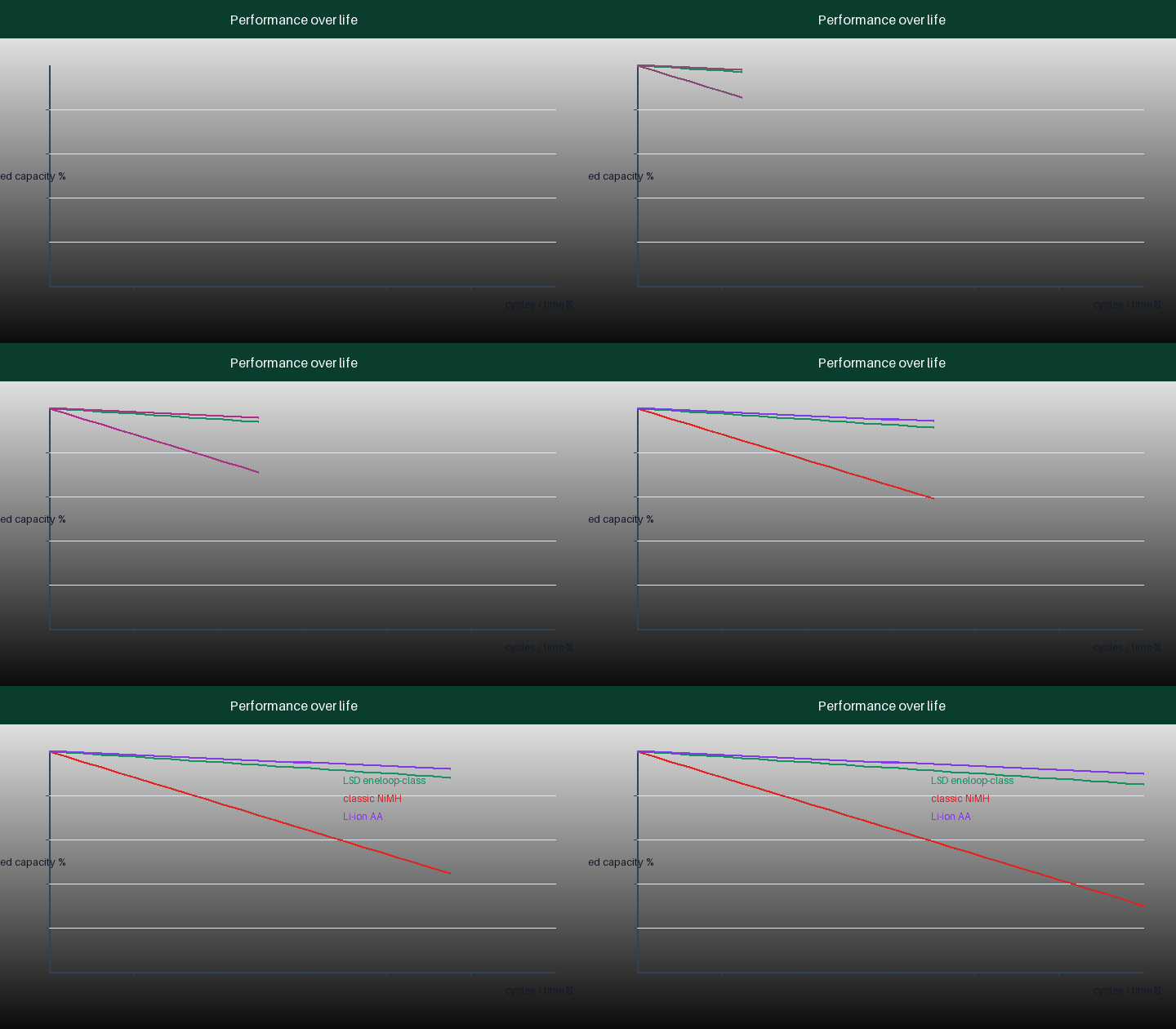
Low-self-discharge design attacks the loss mechanisms in three coordinated places. First, the negative metal-hydride alloy is reformulated - commonly described as a superlattice or refined AB5-type lattice - so hydrogen is bound more stably and is less prone to escape during storage. Panasonic states that improving this alloy lattice is central to eneloop retaining 70 percent capacity after ten years, with the retention figure referenced to IEC 61951-2 (7.3.2) test methodology.
Second, a thinner, more chemically stable sulfonated separator suppresses the shuttle reactions that carry internal current across the cell. Third, the electrolyte volume, seal geometry and can are tuned to limit dry-out and pressure loss over a long calendar life, and the finished cell is charged at the factory - Panasonic uses certified solar power for this pre-charge - so it ships ready to use. The first animated figure contrasts how these choices flatten the retention curve over thirty-six months against the steep decline of classic NiMH.
Independent measurement supports the hierarchy. Wirecutter's long-running rechargeable testing tracked average discharge per thirty days across brands and reported the smallest monthly losses in the low-self-discharge designs - around 0.82 percent for a Duracell AAA, 0.85 percent for an Amazon Basics AAA, 0.97 percent for an Energizer AAA and 1.00 percent for an eneloop AAA, with AA cells somewhat higher at roughly 1.97 percent for eneloop and 3.12 percent for Energizer. The exact ordering shifts between samples and formats, but the structural point holds: modern LSD cells lose roughly one percent a month, an order of magnitude better than the classic NiMH they replaced.
The ten-year manufacturer claim and the one-percent-per-month measurement describe different windows and conditions, and a careful listing should not conflate them. The defensible statement is the one the datasheet supports: a controlled long-storage retention result under the cited IEC method, plus realistic shorter-window expectations.
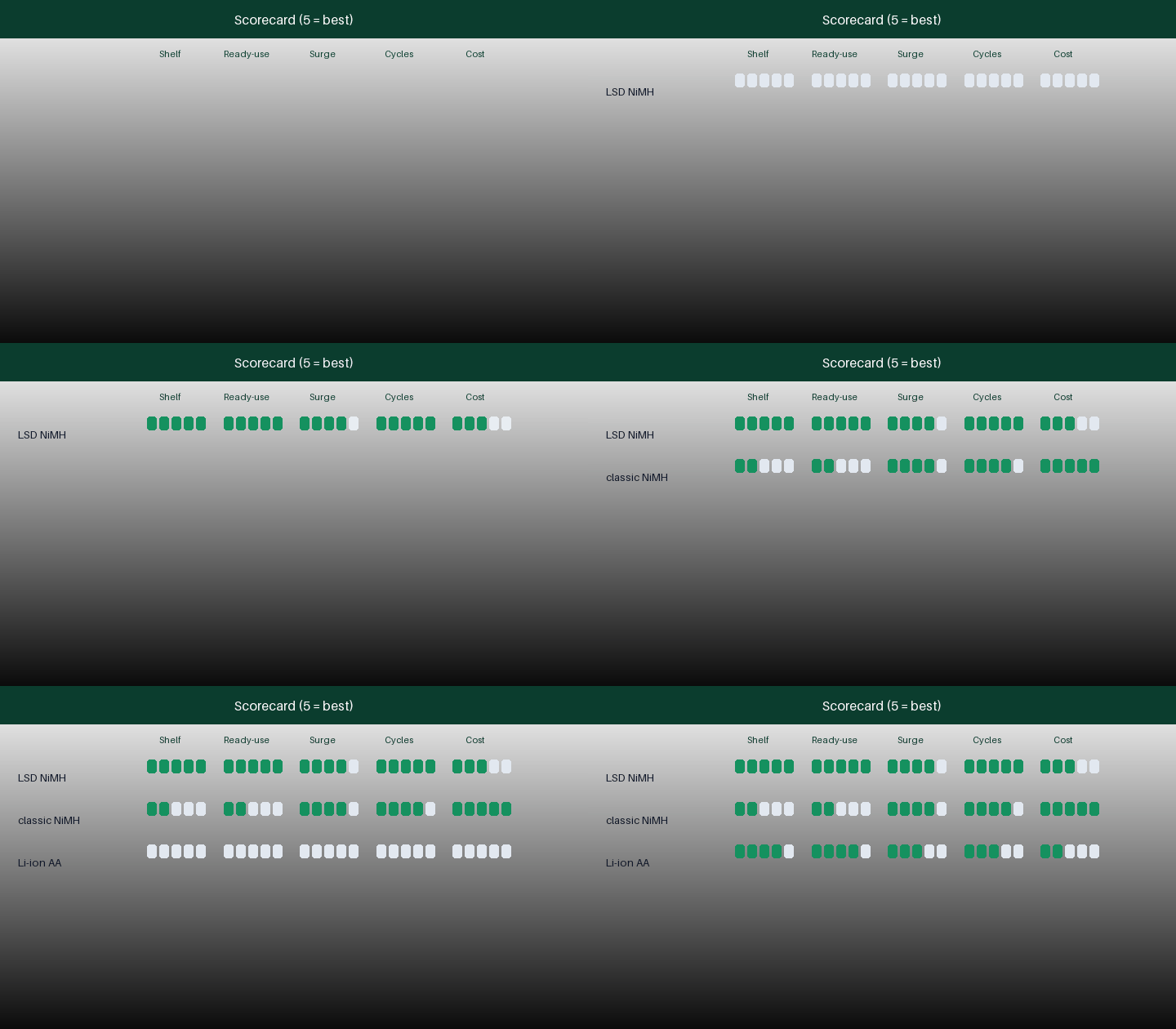
The second animated figure scores LSD NiMH, classic NiMH and the newer regulated 1.5-volt lithium AA on shelf readiness, surge current, cycle life and cost. Ready-to-use matters commercially because it removes the single biggest behavioural barrier to rechargeable adoption: the buyer who opens a device at 11pm does not want to wait four hours for a charge. A pre-charged LSD cell competes with a disposable on the same 'works immediately' axis while still being rechargeable.
It also protects emergency kits, remote controls and infrequently used devices, where a classic rechargeable would be flat precisely when needed. This is why 'pre-charged' and 'holds charge for X years' appear in nearly every winning title and bullet on the shelf: they describe a genuine use-case advantage, not decoration.
There is an engineering trade-off that value listings routinely hide. The same material changes that suppress self-discharge - a more stable alloy and a denser, thinner separator - leave somewhat less internal volume for active material, so a genuine LSD AA commonly rates around 1900 to 2000 mAh rather than the 2800 mAh printed on value cells. A 2000 mAh LSD cell that still delivers 1900 mAh after five years outperforms a 2800 mAh classic cell that has lost a third of its charge in two months and degrades quickly, in every real intermittent-use scenario.
Paper 3 quantifies this 'mAh honesty gap' with independent analyzer data, and Paper 5 formalises the capacity-cycle-retention triangle. For now the lesson for a private label is that matching the premium tier means competing on retention and verified cycles, and resisting the temptation to win the spec-sheet comparison with a number the chemistry cannot sustain.
For WenJoop, an LSD programme is specified from the retention claim backward: select a stable alloy and separator system, validate the 28-day IEC 61951-2 retention result lot by lot, hold a conservative long-storage claim tied to the datasheet, pre-charge and ship ready-to-use, and match cells within each welded pack so that weak cells cannot drag down the strong. The listing then states what the test file proves - retention method, cycle count, minimum rather than maximum capacity - which is precisely the evidence set that prevents the self-discharge complaints analysed in Paper 6.
Low self-discharge won the Amazon shelf because it converted a rechargeable from a planning chore into an immediate, trustworthy product. The brands that keep winning it are those that engineer and document that property rather than merely print it.
Weijiang Power manufactures welded consumer AA, AAA and specialty-size nickel-metal hydride cells and matched packs for private-label and brand sellers on Amazon and other marketplaces, with lot-matched capacity, IEC 61951-2 performance files and IEC 62133-1 safety support. Share your target format, cycle claim, pack configuration and marketplace, and our team will design a defensible, review-resilient NiMH programme. Review the line on the products page.


