The logical endpoint of adaptive and optimal charging is the digital twin: a per-battery computational model that tracks its physical counterpart through life, updated from every charge and discharge, and used to command an individually optimised charge profile - with fleet data continuously improving the models for every battery. Where Paper 41 adapts a profile from local history and Paper 42 optimises against a model, the digital twin fuses both with population-scale learning across a connected fleet. This paper defines what a NiMH digital twin actually computes, how edge and cloud divide the work, how fleet data sharpens degradation and optimal-charge models, and what validation and governance are required before a twin is allowed to command real charge current.
A NiMH digital twin maintains, per battery, the states a charger needs - SOC, internal-resistance parameters, retained capacity, thermal parameters and a degradation coordinate - by running the equivalent-circuit/reduced electrochemical model (Paper 19) against streamed current, voltage and temperature, and correcting it with an observer (Paper 16/20). Unlike a one-shot estimator, it persists the parameter history across the battery's whole life and projects forward: expected capacity at future cycles, time to the end-of-life threshold, and risk under candidate charge profiles.
The twin therefore answers not only 'what is this battery's state' but 'what will happen if I charge it this way', which is the information optimal charging needs.

Real-time control must stay on the edge charger or battery-management controller: current regulation, termination and hard safety limits run locally with millisecond-to-second timing and no dependence on connectivity. The cloud hosts the heavier twin - long-horizon state/parameter estimation, degradation projection and profile optimisation - and periodically pushes an updated, individually tailored charge profile down to the edge. This division keeps safety local while making fleet-scale compute and learning available, and guarantees a valid fallback profile if connectivity is lost.
The edge also buffers and compresses field data (charge curves, peak timing, resistance, thermal response) for upload, so the cloud learns from real operating conditions rather than laboratory cycles alone.
Across a fleet, varied batteries sample the current-temperature-age space far more broadly than any lab study; aggregated, their data refine the degradation model (which conditions actually drive fade, Paper 24), the optimal staircase surfaces (Paper 42) and the distributions of cell-to-cell variation (Paper 29). A new or data-sparse battery starts from the population prior and converges to its individual twin as personal data accumulates - Bayesian/online-learning logic that prevents an individual twin being misled by a few noisy cycles.
This is where the digital twin exceeds a self-contained adaptive charger: the profile a battery receives improves because thousands of other batteries have explored the design space, while still being individualised to its own estimated state.
Operationally, the cloud twin solves the per-battery optimal charge (minimise time subject to that battery's predicted T, pressure and degradation constraints), validates the resulting staircase against hard bounds, and the edge executes it under independent safety limits; outcomes are returned to close the loop, and systematic prediction errors trigger model retraining. Over-the-air profile updates let a manufacturer improve charging for deployed products as models improve - a powerful capability that also demands strict change control, since an erroneous fleet-wide profile update could affect every battery at once.
Canary rollout, shadow-mode evaluation (the twin recommends while the old profile controls), and automatic rollback criteria borrow from software safety practice and are essential before a learned profile commands current at scale.
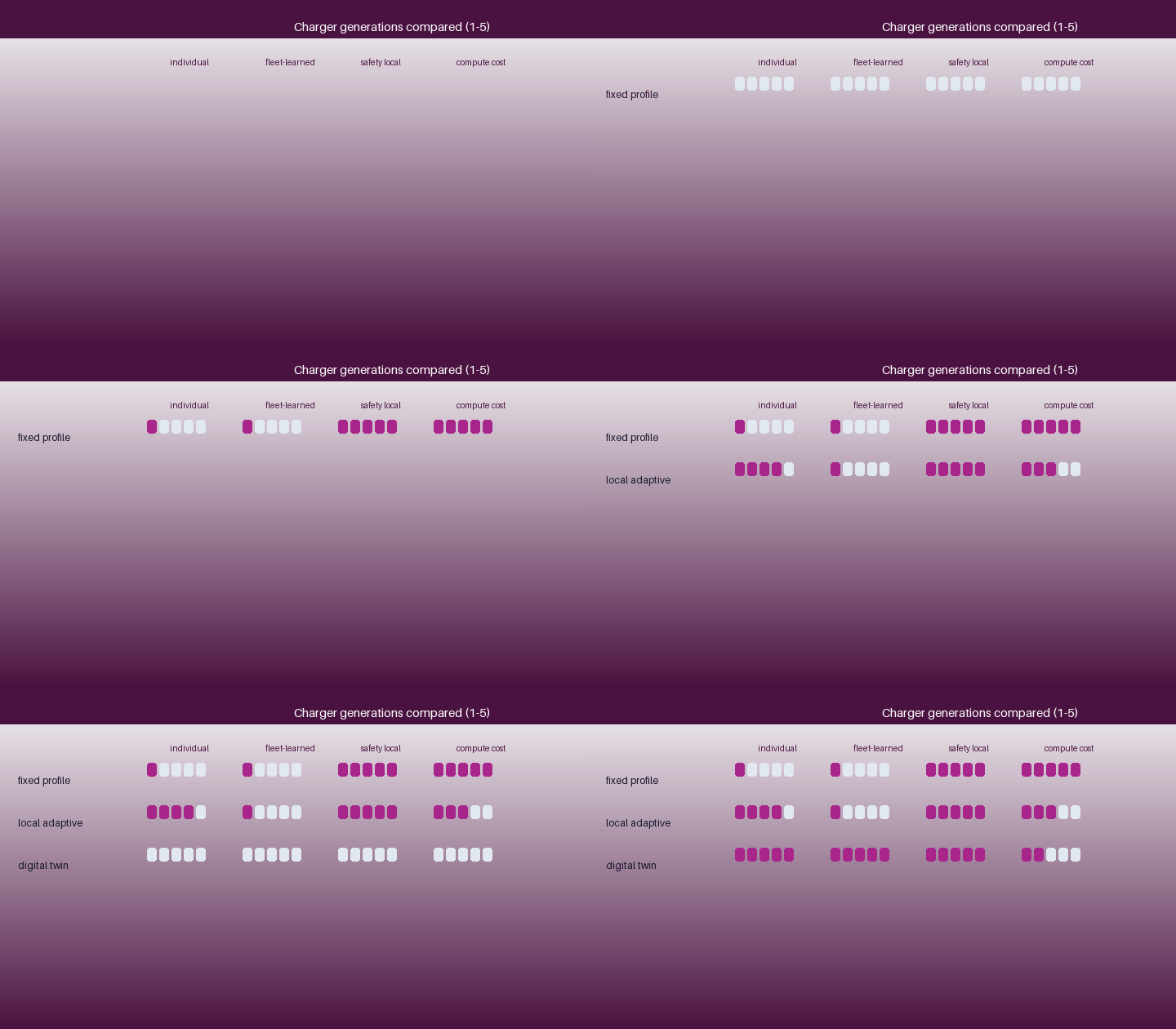
A twin must quantify its own uncertainty and defer to conservative profiles when data are sparse or predictions conflict with direct measurements; hard limits (Paper 40) are never under twin control; data collection respects privacy and ownership, and models are validated against independent long-cycle tests so fleet correlations are not mistaken for causal degradation laws. The first figure contrasts a conventional, locally adaptive and twin-driven charger; the second sequences the edge-cloud closed loop including shadow validation and safe OTA update.
For NiMH specifically, the flat OCV and recombination-dominated end charge make the physical-model core especially valuable - a purely data-driven twin without electrochemical structure extrapolates poorly into the end band, so hybrid physics-plus-data twins are preferred (Paper 20).
A practical roadmap begins with local adaptive charging and logged charge data, adds cloud state/degradation twins, then fleet learning and OTA profile optimisation, always with local hard safety. Weijiang supplies the cell physics and accelerated-ageing data that anchor the population priors and validate twin predictions, so connected NiMH products optimise from a correct electrochemical foundation. The series closes by returning to fundamentals: how NiMH charging is tested, standardised and compared with rival chemistries.
Weijiang Power designs and manufactures nickel-metal hydride cells, matched packs and charging-ready configurations for consumer, industrial, medical and mobility customers, and supports partners with charge-protocol guidance, IEC 61951-2 performance files, IEC 62133-1 safety evidence and charger co-validation. Share your cell format, charge rate, thermal envelope and cycle target and our engineers will specify a cell-and-charge combination that protects both runtime and service life. Review the range on the products page.


