A constant high current gives a NiMH cell no time to catch its breath: concentration gradients steepen, oxygen accumulates and temperature climbs without relief. Pulse and intermittent charging deliberately interrupt current with rest or reduced-current intervals, during which protons redistribute, oxygen recombines and pressure and temperature relax - effectively buying back fast-charge headroom. This paper analyses the physical mechanisms by which pulsation helps, surveys the duty-cycle and frequency choices reported in charger and research practice, distinguishes genuine benefits from folklore, and sets out how to design an intermittent profile whose average current, peak current and rest ratio are matched to a specific cell's relaxation time constants.
When charge current is removed, three relaxation processes begin. Concentration gradients inside the thick positive electrode flatten by solid-state diffusion, reducing the polarisation that moved oxygen onset early; oxygen generated during the pulse continues diffusing to the negative and recombining without new oxygen being produced, so internal pressure falls; and heat dissipates without new Joule input, lowering peak temperature. Each process has its own time constant, from seconds for thermal and electrical relaxation to longer for gas and solid diffusion.
The next pulse therefore starts from a lower-pressure, lower-polarisation state than a continuous current of the same average would maintain, which is the mechanistic basis for pulse charging's ability to sustain a higher peak current without crossing the pressure or thermal ceiling.
A pulse profile is defined by peak current Ipk, rest current (zero or a small value), period and duty cycle; average current Iavg = duty times Ipk. A charger can deliver a given average - and thus a given charge time - with a higher Ipk and lower duty, buying relaxation windows, but pushing Ipk too high reintroduces steep gradients and large instantaneous voltage within each pulse. The design optimum balances peak amplitude against rest length so the cell relaxes meaningfully without the pulse becoming abusive.
Research on multi-stage and pulsed profiles (including PWM solar NiMH chargers and MSCCC/ANFIS-controlled schemes) consistently treats average current and pulse shape as separate design variables, an extra degree of freedom constant-current charging does not have.
Pulse frequency must be matched to the relaxation it intends to exploit. Switching far faster than the diffusion and gas time constants (kilohertz-range) leaves no time for physical relaxation and behaves electrically like DC with extra ripple; switching far slower than necessary simply lengthens charge time. Beneficial intermittent profiles operate on timescales of seconds to tens of seconds, where gas recombination and thermal relaxation actually progress between pulses.
Claims that very high-frequency pulsing achieves dramatic desulfation or capacity restoration in aqueous nickel systems should be treated cautiously; the defensible, evidence-backed benefits are gradient relaxation, pressure management and thermal averaging on the seconds-scale, not resonant 'magic frequencies'.
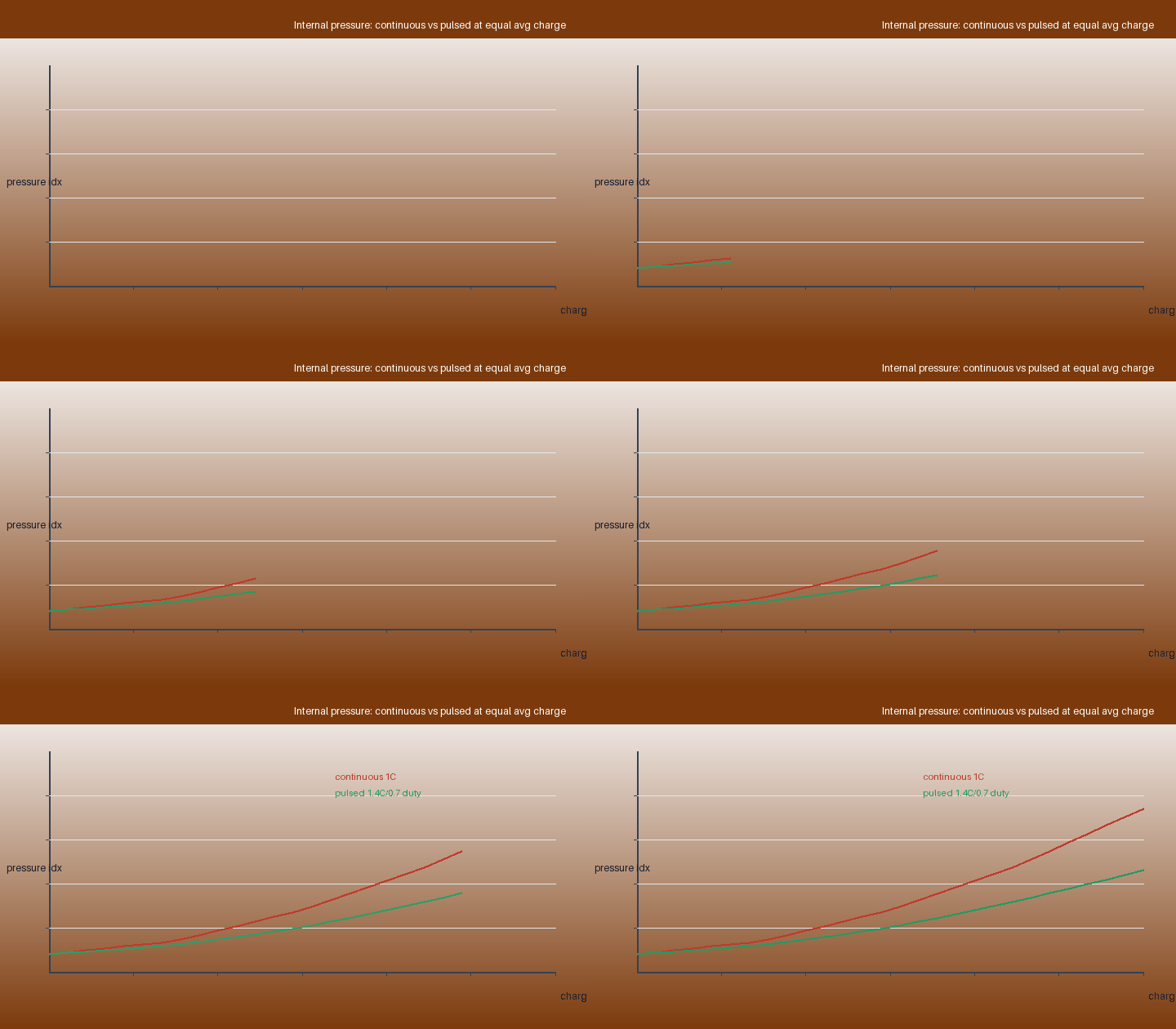
Intermittency is most valuable where continuous charging is most stressed - the high-SOC end band. Replacing a constant 1C push above 70 percent with pulses lets accumulated oxygen recombine during rests, flattening the pressure and temperature climb and pushing the achievable state of charge higher before termination. Traction work showing efficient charging to 93 percent under pressure control is naturally implemented as a current that backs off whenever pressure or its thermal proxy rises - an intermittent, feedback-driven profile.
Pulse maintenance after charge (Paper 9) is the low-duty-cycle limit of the same principle: short pulses separated by long rests match self-discharge without sustained recombination, illustrating one mechanism spanning fast charge and maintenance.

Much quantitative pulse-charging literature originates in lithium-ion work on suppressing lithium plating; those numerical benefits do not transfer directly to aqueous NiMH, whose limiting process is oxygen evolution and recombination rather than plating. Credible NiMH claims rest on measured pressure, temperature and cycle-life comparisons against a constant-current control at equal average current and equal delivered capacity - the only fair test, since a pulsed profile that simply delivers less charge will appear 'gentler' for trivial reasons.
The first figure contrasts pressure under continuous and pulsed current at equal average charge; the second decomposes the relaxation processes during a single rest, giving a visual basis for choosing rest duration from measured time constants rather than guesswork.
Start from the required average current and the cell's measured recombination-limited ceiling; choose Ipk modestly above the continuous limit, set rest length from instrumented pressure-relaxation and thermal-relaxation curves, and tune duty to hit Iavg; then validate by cycling against a constant-current control at equal charge throughput, comparing pressure peaks, temperature, termination SOC and capacity retention. Termination criteria from the prior group apply unchanged, evaluated during pulses on a current-stable basis.
Weijiang can supply pressure-relaxation and thermal time constants for candidate cells, letting partners size pulse rests to real kinetics. A closely related profile with an added negative-current element - Reflex charging - deserves separate scrutiny and is the subject of the next paper.
Weijiang Power designs and manufactures nickel-metal hydride cells, matched packs and charging-ready configurations for consumer, industrial, medical and mobility customers, and supports partners with charge-protocol guidance, IEC 61951-2 performance files, IEC 62133-1 safety evidence and charger co-validation. Share your cell format, charge rate, thermal envelope and cycle target and our engineers will specify a cell-and-charge combination that protects both runtime and service life. Review the range on the products page.


